
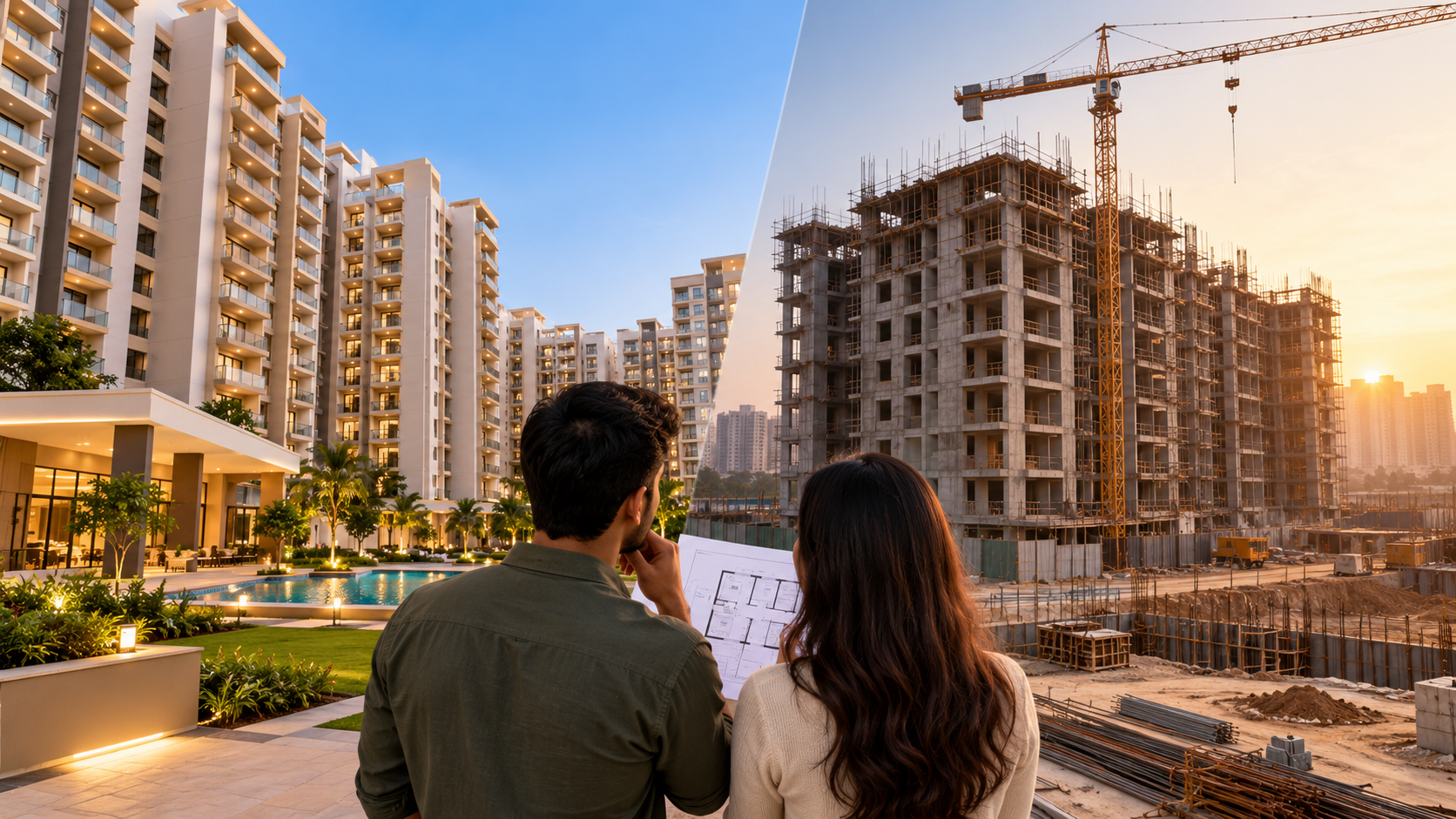
When comparing new Delhi apartments, buyers must decide whether to purchase a ready-to-move home or an under-construction flat. The right choice depends on the total purchase cost, possession timeline, construction risk, financing requirements and intended use. For homebuyers in Delhi NCR, neither option is automatically better; however, a structured comparison can help you choose a property that suits your budget and family needs.
Quick answer: Choose a ready-to-move apartment if you need a home soon and want to inspect the completed property before purchasing. Consider an under-construction apartment if its planned completion timeline, payment schedule, location and documented project details fit your circumstances. In both cases, verify approvals, title documents, costs and applicable RERA records before committing.
What Is the Difference Between Ready-to-Move and Under-Construction Flats?
A ready-to-move flat is a completed residential unit that is available for occupation, subject to the required approvals and applicable occupancy or completion documentation. An under-construction flat is part of a development that has not yet reached the relevant completion and possession stage.
However, the phrase "ready to move" in a property advertisement should not replace document verification. Buyers should confirm the building's legal status, applicable completion or occupancy certificate, the seller's authority to transfer the unit and any outstanding dues.
What Are Ready-to-Move Apartments?
Ready-to-move apartments allow buyers to inspect the actual unit, building access, common areas and visible construction quality before making a purchase decision. Additionally, buyers can assess the surrounding neighbourhood and check practical details such as parking, ventilation, road access and nearby services.
This option can suit families who need to relocate quickly, buyers who currently pay rent, and people who prefer to evaluate a completed property rather than rely mainly on proposed plans and specifications.
What Are Under-Construction Apartments?
Under-construction apartments are purchased before the development has reached its completed, occupiable stage. Depending on the project, buyers may select from available configurations and pay according to the agreed payment schedule.
Nevertheless, the buyer must account for construction progress, contractual possession dates and the possibility of delays. Therefore, verify the project's registration and disclosures with the relevant state Real Estate Regulatory Authority (RERA), review the agreement for sale and assess whether your finances can accommodate a longer wait.
Ready-to-Move vs Under-Construction Flats: Key Differences
The most useful comparison goes beyond the advertised price. Consider when you can occupy the property, what you can inspect before purchase and how long your money may remain committed before possession.
| Buying factor | Ready-to-move flat | Under-construction flat |
|---|---|---|
| Possession | Potentially available sooner, after legal and handover checks. | Depends on construction progress and the contractual possession timeline. |
| Physical inspection | Buyers can inspect the actual apartment and completed common areas. | Inspection is limited to the stage of construction; some features remain unbuilt. |
| Payment schedule | May require a larger payment upfront or financing arranged for a near-term transfer. | May follow construction-linked or other contractual instalments. |
| Delay exposure | Construction completion risk is lower, but legal or handover issues may remain. | Construction delays can affect the possession date and housing plans. |
| Visible construction quality | Finishes and many common areas can be inspected directly. | Final finishes and long-term performance may not yet be assessable. |
| Neighbourhood assessment | Existing traffic, occupied buildings and nearby services can be evaluated more directly. | Some surrounding infrastructure and community facilities may still be developing. |
| Best suited to | Buyers who prioritise earlier occupation and inspection of the completed unit. | Buyers who can wait and have assessed the developer, project documents and timeline. |
What does this comparison mean? A completed flat offers more immediate visibility, but that does not automatically make it legally sound or fairly priced. Similarly, an under-construction apartment is not necessarily cheaper or riskier in every case. Compare the actual documents, total costs and delivery circumstances of each property.
What Should You Include in the Total Cost of New Delhi Apartments?
The advertised price is only one part of the purchase decision. For a realistic comparison, prepare a written cost sheet for each shortlisted property and ask the seller or developer to explain every charge.
1. Compare the Complete Purchase Cost
Request an itemised breakdown covering the base price, applicable taxes, registration and stamp duty, parking or other charges where applicable, maintenance deposits, utility connections and any other contractual payments. Charges vary according to the transaction, property and applicable rules, so do not assume every fee applies to every apartment.
2. Understand GST and Property Status
Goods and Services Tax (GST) treatment depends on the nature and stage of the property transaction. A sale of a completed building generally falls outside the construction-service treatment when the entire consideration is received after the relevant completion certificate or first occupation, whichever is earlier, subject to the applicable legal provisions. Under-construction purchases may attract GST depending on the transaction and applicable rules.
Before budgeting, ask for written clarification on tax treatment from the seller and a qualified tax professional. Do not use a generic GST percentage to calculate every property's final cost.
3. Calculate the Cost of Waiting
If you are renting while waiting for an under-construction apartment, include rent and moving costs in your financial plan. Also consider loan interest or pre-EMI payments, where applicable, and the possibility that the actual possession date may differ from your expected date.
For a ready-to-move property, consider the cost of immediate occupation, any repairs or interior work, maintenance charges and the time needed to complete registration and handover. Therefore, compare the overall financial impact rather than just the quoted apartment price.
4. Review Your Home Loan Affordability
Before making a booking, calculate the down payment, expected monthly instalment, emergency savings and other household expenses. For an under-construction property, check how the lender disburses the loan and how instalments or interest may change as construction progresses.
Tax deductions and loan benefits depend on the applicable tax regime, property use and eligibility conditions. Review current guidance from the Income Tax Department or consult a tax professional instead of assuming a particular deduction will apply.
Possession Delays, Construction Quality and Legal Checks
Property due diligence matters whether you are purchasing a completed apartment or booking a unit that is still under construction. However, the most important checks differ according to the property's stage.
Verify RERA Registration and Project Disclosures
For a project in Uttar Pradesh, use the Uttar Pradesh Real Estate Regulatory Authority (UP RERA) portal to look up relevant project records and disclosures. For projects in Delhi, consult the appropriate Delhi RERA resources. Confirm that the project name, promoter, registration details and available records match the property being offered.
RERA registration is an important verification step, but it does not replace independent legal due diligence or guarantee that a project will never experience a delay.
Understand Your Rights if Possession Is Delayed
Section 18 of the Real Estate (Regulation and Development) Act, 2016 addresses refund and compensation in specified circumstances where a promoter fails to complete a project or give possession in accordance with the agreement. The available remedy depends on the statutory conditions and the buyer's circumstances.
Read the agreement for sale carefully, especially the possession date, extension provisions, payment obligations and remedies for delay. If a dispute arises, seek advice from a qualified lawyer or the relevant regulatory authority.
Inspect the Apartment and Building
For a completed property, inspect the apartment and common areas in person. Where possible, assess visible cracks, dampness, ventilation, water supply, electrical fittings, lifts, fire-safety provisions and parking arrangements. A qualified technical professional can help identify issues that a general walkthrough may miss.
For an under-construction unit, compare the sanctioned plans and contractual specifications with the work completed to date. Ask how construction progress is documented and check whether proposed amenities, layouts and finishes match the relevant approved and contractual documents.
Check Title, Approvals and Handover Documents
Request a review of the title and relevant land records, applicable building approvals, encumbrances, sale agreement and the documents required for registration and possession. For a completed building, verify the applicable completion or occupancy documentation with the relevant authority. Requirements can vary according to the location and type of property.
A Practical Checklist for New Home Buyers
Use this checklist before paying a booking amount or signing a property agreement. It is especially useful when comparing several new Delhi apartments or searching for real estate near me across different parts of Delhi NCR.
- Confirm the location: Check your daily commute, road access, public transport options and the availability of essential services.
- Verify the developer and project: Review the relevant RERA records, promoter details, project disclosures and available completion information.
- Read the agreement: Check the unit description, carpet area, payment schedule, possession date, additional charges and applicable remedies.
- Compare the full cost: Obtain an itemised cost sheet and account for taxes, registration, financing, maintenance and moving expenses.
- Inspect what is available: For completed apartments, inspect the unit and building. For ongoing construction, review progress and contractual specifications.
- Assess your finances: Check loan eligibility, monthly affordability, savings and the cost of waiting if possession is not immediate.
- Get independent advice: Have a property lawyer review material documents and consult a qualified tax professional where needed.
Which Option Is Better for Buyers in Delhi NCR?
The better choice depends on your intended move-in date, finances and willingness to wait. Use the following decision framework rather than relying on a general claim that one type of property is always superior.
Choose a Ready-to-Move Flat If You Need to Move Soon
A ready-to-move property may be suitable if your family needs a home within a short timeframe, you are currently paying rent or you want to inspect the completed unit before making a decision. However, confirm the property's legal status and all outstanding charges before proceeding.
Consider an Under-Construction Flat If You Can Wait
An under-construction apartment may suit buyers with a flexible timeline who have assessed the developer's track record, reviewed the project's documents and understood the payment schedule. Additionally, consider whether the proposed location and configuration meet your family's long-term needs.
Use Real Estate Investment Advice to Evaluate the Whole Decision
When buying for investment rather than immediate occupation, examine rental demand, vacancy risk, recurring costs, resale considerations and the property's total acquisition cost. Do not treat an advertised appreciation estimate or a location's popularity as a guaranteed return.
Good real estate investing tips begin with verification, not speculation. Compare properties using consistent criteria and base your decision on evidence that you can independently check.
Residential Projects to Explore in Delhi NCR
If you are comparing residential options around Delhi NCR, start by identifying the locations and configurations that fit your requirements. Divyansh India lists projects in the region, including completed and ongoing developments. Review each project's current status and documentation before treating it as a match for your needs.
Divyansh Arc Angel, Raj Nagar Extension, Ghaziabad
Divyansh Arc Angel is presented on the developer's website as a completed, ready-to-move residential development in Raj Nagar Extension, Ghaziabad. The project page lists 2 and 3 BHK homes and describes its location along NH-58. Buyers should confirm current availability, pricing, legal documents and applicable possession records directly before making a decision.
Divyansh Green Heights, Greater Noida
Divyansh Green Heights is presented on the developer's website as a residential project in Greater Noida with 3 and 4 BHK configurations. If you are considering this development, ask the sales team for its current construction status, expected possession timeline, applicable RERA details, complete cost sheet and contractual specifications.
These project descriptions are based on information published by the developer and are not independent endorsements. Compare the available documents, location, affordability and project status before deciding which property to visit.
Frequently Asked Questions
1. Are ready-to-move flats better than under-construction flats?
Ready-to-move flats may suit buyers who need earlier occupation and want to inspect a completed unit. Under-construction flats may suit buyers who can wait and have assessed the project, developer and contractual timeline. The better option depends on your circumstances and due diligence.
2. What should I check before buying new Delhi apartments?
Verify the property's title and applicable approvals, project registration where required, the agreement for sale, total purchase cost, payment schedule and possession or completion documents. Also assess the location, construction quality and your ability to afford the property.
3. Can an under-construction flat be cheaper than a ready-to-move flat?
It can be, but this is not guaranteed. Compare the actual quoted price, taxes where applicable, payment terms, financing costs, expected rent during the wait and other charges before deciding which option is more economical.
4. How can I check whether a property project is RERA-registered?
Search the relevant state RERA authority's official portal using the project name, promoter or registration number. Check that the information matches the property being offered, and review the available project disclosures and status records.
5. What happens if a developer delays possession?
Your rights depend on the agreement, applicable law and the facts of the case. Section 18 of the Real Estate (Regulation and Development) Act, 2016 addresses specified refund and compensation remedies. Consult the relevant RERA authority or a qualified lawyer to understand your options.
6. Should I buy an apartment close to my workplace?
Commute time is an important factor, but it should not be the only one. Compare transport options, household needs, total cost, access to services, building quality and the suitability of the neighbourhood for your long-term plans.
7. How do I compare apartments when searching for real estate near me?
Shortlist properties by location, budget, configuration and intended move-in date. Then compare total costs, project documentation, connectivity and physical condition. Visit the shortlisted properties and verify key claims before paying a booking amount.
8. What is the most important advice for first-time homebuyers?
Do not base the decision only on promotional claims or the advertised price. Review the relevant legal documents, understand the complete cost, assess your finances and obtain independent professional advice when needed.